12 Days Before Christmas Series: #11 – 5 minute read time
Read: Luke 2:22-40
When reading the Christmas Story and exploring the roots of early Christianity, you may notice how exclusive it first appears. Several key Bible passages highlight that the story centers on the birth of the Jewish Messiah—Jesus, born into the heritage of Israel.
For example, in Matthew 1:18, the angel Gabriel tells Joseph that Jesus (Yeshua) will “save his people from their sins.” Gabriel also assures Mary that Jesus “will be given the throne of his father David, and he will reign over the house of Jacob forever” (Luke 1:32-33). Zechariah, father of John the Baptizer, prophesies that God “has raised up a horn of salvation for us in the house of his servant David,” and that the Messiah will “give the knowledge of salvation to his people” (Luke 1:69, 77).
This focus on Israel was deeply felt in the early church, which was comprised entirely of Jewish believers. The idea that Gentiles—meaning anyone who was not Jewish—could be included was a major challenge for them (see Acts 10–11, Acts 15, and Galatians 2:11-14). Gentiles were simply those whose parents weren’t Jewish, and while conversion to Judaism was possible in the Old Testament, it required adopting all the Jewish laws and customs.
Yet even from the beginning, hints of a broader purpose emerge—let’s look at how Jesus’ arrival signals a turning point for all humanity.
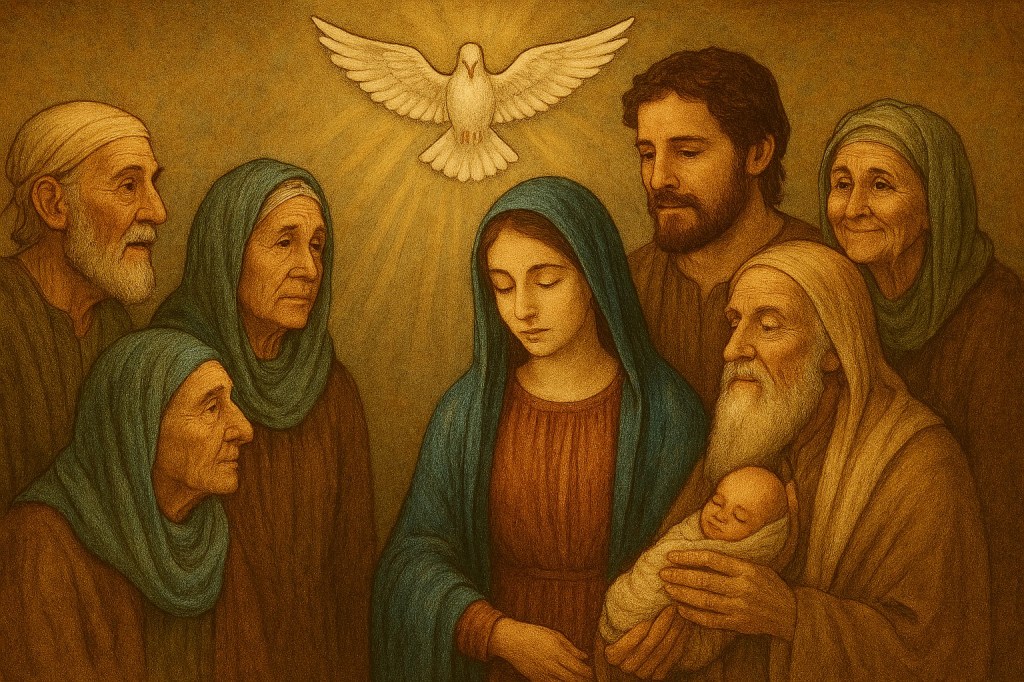
There are clues, even in the Christmas narrative, that Jesus came for everyone—Jews and Gentiles. The angels in Luke 2:10 announce good news and great joy for all people, not just for those of Jewish descent. And when Simeon, described as a ‘senior-saint,’ meets the Christ child in the temple, he prophesies that Jesus is “a light for revelation to the Gentiles, and for glory to your people Israel” (Luke 2:29-32).
We find hints of this theme in other places in Scripture. In Matthew 15:21-28 a Canaanite woman is begging Jesus to deliver her demon possessed daughter. Jesus, like the straight man in a comic duo setting up the punchline, says, “I was sent only to the lost sheep of the house of Israel” – the house the Canaanite woman does not belong to. Jesus continues wryly, knowing what’s coming, “It is not right to take the children’s bread and throw it to the dogs.” The woman replies, “Yes, Lord, yet even the dogs eat the crumbs that fall from their masters’ table.”
She had great faith in this Jewish Messiah, and her daughter was healed instantly.
When Jesus is talking to the Pharisee Nicodemus in the middle of the night (John 3:16-21), Jesus says something that we’ve become accustomed to but Nicodemus would have been shocked at.
Nicodemus might have been expecting, God so loved the Jews … the Jew that believes in him … God condemns the world … The world is outside of the covenant and could never be saved. What he heard Jesus say was, “God so loved the world, that he gave his only Son, that whoever believes in him should not perish but have eternal life. For God did not send his Son into the world to condemn the world, but in order that the world might be saved through him.”
Before Jesus ascended into heaven after his resurrection, he plainly stated his intentions to his disciples – “make disciples of all nations.” (Matthew 28:16-20) and when asked when he was going to restore the kingdom to Israel, Jesus told his disciples that they would be his witnesses to the end of the earth. (Acts 1:6-11) Yet the early church struggled with this concept well into the book of Acts.
What Jesus brought was a light to the Gentiles (Isaiah 49:6; Acts 13:47). He was the culmination of God’s plan to reclaim the people he divorced from his family after the Tower of Babel (see Genesis 11:1-9; Deuteronomy 32:8-9; Psalm 82:1-8 – this is probably another blog series in the future). He was the fulfilment of God’s promise to Abraham in Genesis 12:1-3, “in you [Abraham] all the families of the earth shall be blessed.”
Far from being exclusive, Jesus was the answer to questions formed thousands of years earlier. What happened to the descendants of all of the nations after they rejected God at the tower of Babel? Does God love ONLY the Jews? Does God care about me, even if my parents weren’t Jewish?
You might have questions of your own. Does God love me? Does he see me? Does he care about me? Is there any hope?
The answer to all of our questions, was given in that evening conversation with a Jewish Pharisee. “God so loved the world, that he gave his only Son, that whoever believes in him should not perish but have eternal life. For God did not send his Son into the world to condemn the world, but in order that the world might be saved through him.”
And that is good news of great joy for ALL people – Jews and Gentiles. The light has come, and his name is Jesus.
If you’d like to read the entire Christmas story as it unfolded over 2,000 years ago, check the first blog in this series for scripture references. Got questions? Reach out anytime—I’ll do my best to find an answer.
Return tomorrow for: The Recap




 curtferrell.com
Leave a reply to The Holy Spirit Was Busy! – curtferrell.com Cancel reply