The first chapter from The Way to Discipleship
The mission couldn’t be any clearer. Make disciples (Matthew 28:18-20; 2 Timothy 2:2; 2 Timothy 3:16-17; Colossians 1:28-29). The church has embraced the mission and even given it a special name – The Great Commission. After the resurrection, Jesus was given all authority in heaven and earth, including authority over the mission. The Holy Spirit was given to the church to accomplish the will of God on earth as it is in heaven. And yet, there is a problem as noted in a recent study.
A 2020 study of churches in the United States found that fewer than five percent of churches have a “reproducing disciple-making culture.” Many Protestant pastors claim to have effective disciple-making activities but cannot point to any significant spiritual impact made by these activities. Unfortunately, nearly thirty percent of congregations have a negative impact on disciple-making because they don’t intentionally focus on helping others make disciples or grow in their relationship with Christ.
Christian philosopher and theologian Dallas Willard observed that in the church there is an even deeper problem. One “is not required to be … a disciple in order to become a Christian, and one may remain a Christian without any signs of progress toward, or in, discipleship.” “We have multitudes of professing Christians who well may be ready to die but obviously are not ready to live, and can hardly get along with themselves, much less with others.”
The mission is clear. The church has embraced the mission. Christ has given the church authority (Matthew 28:18-20; Luke 10:19; Genesis 1:26-28) and the power (Acts 1:8) to accomplish the mission. However, nearly all Christians today assume that we can ‘be “Christians” forever and never become disciples.’ In practice, discipleship has become an optional “add-on” for extra credit in our pursuit of Christ. So where is the disconnect?
I believe the disconnect is due to a series of slight but significant misunderstandings of key biblical concepts, including the Great Commission. A one-degree error in navigation can, over time, be disastrous. In the physical world, navigators have found a way to avoid disaster.
In a long journey by plane, there are several “waypoints” designated by GPS that mark what amounts to intersections in imaginary highways in the sky. At each of these waypoints, pilots, or more commonly computers, make slight course corrections to keep the plane headed in the right direction. In a long journey, say across a continent or ocean, a one-degree error could result in being miles from your intended destination. A one-degree error in a journey to the moon could prove deadly. If discipleship is the church’s moonshot, we are headed for deep space and a cold, dark future.
Fortunately, making a series of minor course corrections at seven waypoints in our journey could put us back on the path toward our intended destination. As presented here, The Way to Discipleship: Thinking Well About the Kingdom of God provides ministry leaders with the biblical foundation to accurately define discipleship and to design and evaluate whether their ministries are in alignment with that definition.
The Way to Discipleship: Thinking Well About the Kingdom of God helps ministry leaders utilize scripture to deconstruct a faulty image of discipleship, and then, using small but significant one-degree course corrections, reconstruct a biblically defined vision of what discipleship looks like in their ministry context.
You may be tempted to get to the destination quicker and bypass one or more of these waypoints, but each course correction is crucial to safely arriving at our destination. Like any flight, much of our journey will be through blue skies. However, we may occasionally encounter turbulence when the warm air of scripture rises over the cooler air of tradition.
Our Compass – Seek First the Kingdom of God
And since GPS only works for a physical journey, we will need a spiritual compass for making each of these one-degree course corrections. Our compass is found in Matthew 6:33 (ESV): “Seek first the kingdom of God …” If we are seeking the Kingdom of God first, we won’t have to be anxious about our discipleship efforts. We will be back on course toward an exciting new country!
Imagine a land where gift-based ministry surpasses program-based ministry. Picture discipleship that not only imparts knowledge about the Kingdom of God but also transforms passions and desires. Envision a world where disciples will not only have a solid Scriptural foundation but there will also be a revolution in their habits and responses to challenging situations. In this world ministry leaders could be freed from administrative tasks, enabling them to invest more time in long-term, intentional relationships that produce disciples who make more disciples.
This could be the destination for your ministry if you allow your compass and The Way to Discipleship: Thinking Well About the Kingdom of God to pilot you through these minor course corrections. If you are ready to go, the gate is open, and you are free to board.
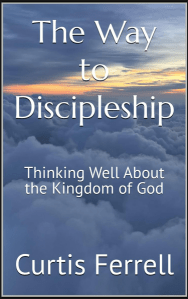
Want to read more? Get your copy of The Way to Discipleship: Thinking Well About the Kingdom of God today!



 curtferrell.com