12 Days Before Christmas Series: #9 – 5 minute read time
Read: Luke 2:1-7; Matthew 2:1-23
WARNING: Buckle up, because by the end of this blog, you might feel like you’ve just survived a rollercoaster ride through a biblical family reunion. Don’t worry—by the time we’re done, we’ll have untangled most of this wild family tree (really, I’ll try my best) and you’ll be ready to impress your friends at any Christmas party with your newfound knowledge of Caesars, Herods, and all their complicated connections.
The Caesars and Herods: Too Many Rulers, Not Enough Name Tags
The Bible mentions Caesar 29 times and Herod 43. If you’re not up on your first-century Judean politics, it’s easy to get lost. Think of it like talking about “the U.S. President”—which one? There have been 45! And if you narrow it down to Adams, Bush, Harrison, Johnson, and Roosevelt, well, that’s actually ten presidents—two of each. See how fast things get confusing?
During Jesus’s earthly life, there were two Caesars worth noting: Caesar Augustus, founder of the Roman Empire and the census guy (he’s why Mary and Joseph trekked to Bethlehem), and Caesar Tiberius, ruler during Jesus’s crucifixion. Later, Luke’s sequel (Acts) mentions Claudius and Nero, but they’re minor characters in our story. Compared to the Herods, keeping track of the Caesars is a walk in the park.
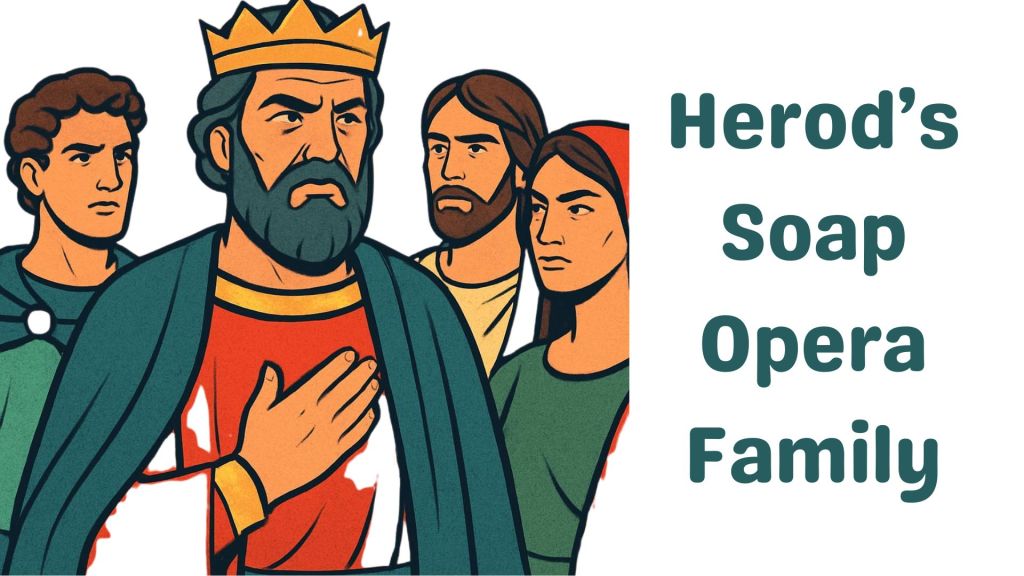
Herod the Great and His Descendants: The Family Tree from a Soap Opera
Meet Herod the Great, King of Judea and starter of the Herod dynasty. He’s infamous for ordering the massacre of baby boys in Bethlehem (Matthew 2). Fun fact: Herod was a descendant of Esau (remember Jacob’s brother who swapped his birthright for a bowl of soup in Genesis 25?). Many Jews didn’t consider Herod a true Jew, which just added spice to this already dramatic family saga.
Herod the Great had several children, and here’s where things get messy. Herod Archelaus was “Tetrarch” (let’s call it a sub-king) over parts of Judea, while Herod Antipas bossed around Galilee and other regions. Archelaus shows up at the end of Matthew 2, making Joseph move his family to Galilee where Antipas ruled.
Textual Chart: Herods and Philips—Who’s Who?
Let’s pause and sketch out a simplified “textual chart” to keep things straight—think of it as the family group chat, minus the drama:
- Herod the Great (the patriarch, King of Judea)
His kids:
- Herod Archelaus (Tetrarch of parts of Judea)
- Herod Antipas (Tetrarch of Galilee)
- Philip(s) (there were at least one, possibly two—both called Philip)
- Granddaughter Herodias (married first to one Philip, then to her other great-uncle, Herod Antipas)
- Her daughter (Salome—though not named directly in the Bible, that’s the tradition), whose dad was one of the Philips.
Recap: Untangling the Herod Hairball
Let’s recap before our brains fry: Herod the Great is the big boss. He had sons—Archelaus (Judea), Antipas (Galilee), and at least one Philip (possibly two). Herodias, Herod the Great’s granddaughter, married one Philip (her great-uncle), then divorced him to marry her other great-uncle, Antipas. Her daughter (Salome) danced for Antipas—her stepdad and another uncle. Yes, it’s as tangled as the plot of a soap opera, and no, you’re not alone if you need to reread this part.
Herod Antipas and John the Baptizer: A Birthday Party No One Wanted
Now that you’ve got your Herods straight (or mostly straight), let’s focus on Herod Antipas and the thorn in his side – John the Baptizer. You can probably understand why John the Baptizer, whose job was to call Jews to repentance in preparation for the Messiah, was livid with Antipas and Herodias for their flagrant immorality (Matthew 14). Here’s where the family drama really heats up thanks to Herodias.
At Antipas’s birthday bash, Herodias orchestrates a plan: her daughter dances provocatively for Antipas, and he’s so impressed (or flustered) he promises Salome anything. Her request? John the Baptizer’s head on a platter—a direct hit from the family’s complicated relationships. Cue the “Jerry Springer” theme music.
Before we bounce from royal family feuds to geography, let’s take a deep breath and shift the scene from Antipas’s palace drama to the north of Israel—because the story is about to get supernaturally confrontational.
Caesarea Philippi: Where History, the Supernatual, and Jesus Collide
Philip the Tetrarch (remember one of the Philips?) founded Caesarea Philippi to honor Caesar Augustus. This city sat at the base of Mt. Hermon, north of Israel—the site of Genesis 6:1-4’s strange happenings that led to the Great Flood (but let’s save that for another blog series).
Mt. Hermon hosted shrines and a cave known as “the gates of hell.” The main deity here was Pan (yes, the origin of the word “panic”—I told you not to panic!). Here’s the curveball: Jesus took his disciples to Caesarea Philippi and, right there at Pan’s turf, declared, “on this rock I will build my church, and the gates of hell will not prevail against it!” (Matthew 16:13-20). That’s not just good timing—that’s bold Kingdom of God strategy.
Conclusion: Don’t Panic—The Kingdom of God Wins
So, there you have it—a whirlwind tour of Caesars and Herods, a family tree worthy of its own reality show, and a reminder that even at the epicenter of chaos and immorality, Jesus was never fazed. He went straight to Pan’s home base and announced, “There’s a new King in town!” No need to panic about tangled families or ancient politics; the real victory is already declared.
If you want to read the whole Christmas story as it happened over 2,000 years ago, check the first blog in this series for scripture references. Got questions? Reach out anytime—I’ll do my best to clarify even the wildest family trees.
Return tomorrow for: The Holy Spirit Was Busy!





Leave a Reply